

How Equatorial Ground Station Services Optimize High-Throughput Satellite Operations
As satellite operators demand higher data rates, lower latency, and more predictable performance, Ka-band has become the preferred frequency band for Earth observation, connectivity, and data relay systems.
At the same time, the effectiveness of Ka-band missions increasingly depends on the quality, location, and scalability of their ground segment. Ground Station as a Service (GSaaS), particularly when delivered from equatorial locations, is emerging as a strategic enabler for next-generation satellite operations.
In this article, we explain how Equatorial Ground Station Services strengthen Ka-band performance and why Equatorial GSaaS is becoming a core component of modern satellite ground networks
1. Ka-Band Performance in Modern Satellite Ground Networks
Ka-band (approximately 26 to 40 GHz) enables high-capacity satellite communications through wider bandwidths and higher spectral efficiency. It is now widely used in LEO, MEO, and GEO missions supporting Earth observation, connectivity, and data relay.
However, Ka-band links are more sensitive to atmospheric attenuation, antenna pointing accuracy, slant range variations, and Doppler dynamics. These factors make the ground segment a critical performance driver.
In high-frequency missions, satellite ground station services directly influence data delivery, latency, and operational reliability. As a result, GSaaS providers are increasingly expected to deliver not only access, but optimized end-to-end ground infrastructure.
2. Why Equatorial Ground Station Services Improve Link Geometry
Link geometry becomes increasingly important at higher frequencies. At Ka-band, elevation angle and slant range have a direct impact on link margins and achievable data rates.
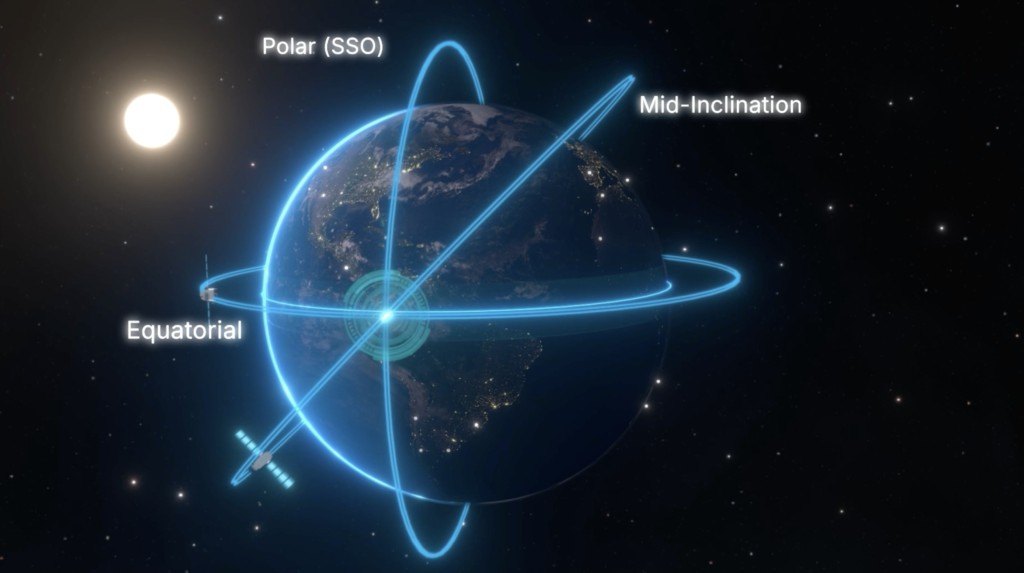
Equatorial ground station services benefit from consistently favorable geometry for low- and mid-inclination satellites. This results in:
- Higher average elevation angles
- Shorter propagation distances
- More symmetric satellite passes
These characteristics improve modulation efficiency and maximize usable contact time. For satellite operators, this means higher throughput per pass without increasing spacecraft complexity.
Equatorial GSaaS providers therefore deliver structural performance advantages that cannot be replicated through equipment alone.
3. Atmospheric Resilience in Equatorial GSaaS Networks
While equatorial regions experience higher precipitation, Ka-band performance depends primarily on effective atmospheric path length rather than latitude.
Because equatorial teleports observe satellites at higher elevation angles, signals traverse less atmosphere and experience shorter fade events. When combined with adaptive coding and modulation, intelligent pass scheduling, and site diversity, equatorial ground station networks achieve high availability.
Modern Equatorial GSaaS platforms integrate climate data, network analytics, and predictive maintenance to ensure consistent satellite data downlink services.
4. Signal Stability and Frequency Behavior
As satellites move relative to the ground station, their signals change frequency slightly. This is a natural physical effect caused by motion, similar to how the pitch of a siren changes as it passes by.
In satellite communications, these frequency variations must be continuously tracked and corrected by both the spacecraft and the ground station to maintain a stable link. If they change too quickly or unevenly, systems become harder to manage and more prone to errors, especially at high data rates.
Equatorial ground stations experience more balanced and predictable satellite passes. Because satellites rise and set more symmetrically near the equator, frequency changes remain smoother and easier to compensate.
This results in:
- More stable links during high-rate data downlinks
- Simpler design of radios and ground systems
- Lower risk of signal loss during critical operations
- Better performance in automated and autonomous missions
In practical terms, equatorial alignment reduces technical complexity and improves operational reliability, particularly for Ka-band systems where precision and stability are essential.
5. Economics of Equatorial Ground Station as a Service
Ground Station as a Service reduces capital expenditure by allowing operators to access shared infrastructure instead of building dedicated sites. However, not all GSaaS platforms deliver the same economic value.
Equatorial GSaaS improves return on investment by increasing antenna utilization and reducing the number of sites required for global coverage. It enables multi-mission, multi-constellation operations from a smaller physical footprint.
From a commercial perspective, this leads to lower cost per delivered gigabit, predictable capacity scaling, and improved service margins.
6. Equatorial GSaaS as a Platform for Future Satellite Systems
Future satellite missions will increasingly rely on integrated ground segments that connect spacecraft, cloud platforms, and user applications in real time.
Equatorial ground station services support this evolution by providing:
- High-throughput multi-band access
- Global interconnection points
- Cloud-ready data interfaces
- Long-term infrastructure scalability
Rather than serving individual missions, modern equatorial teleports function as digital hubs within global satellite data ecosystems.
Equatorial GSaaS as a Competitive Advantage
Ka-band enables the next generation of satellite performance, but only when supported by optimized ground station services.
Equatorial GSaaS delivers structural advantages in geometry, atmospheric resilience, Doppler stability, and operational efficiency. For Ka-band missions, equatorial ground station services are no longer optional infrastructure. They are strategic assets that define mission scalability and commercial success.
How Astralintu Delivers Equatorial Ground Station Services
Astralintu is developing an Equatorial Ground Station Network designed to support high-performance LEO, MEO, and GEO missions through scalable Ground Station as a Service.
Our flagship facility, Equatorial Stargate, supports a wide range of satellite missions through a flexible, multi-band architecture and resilient ground infrastructure. Full technical specifications and configuration options are available through our team.
Technical Capabilities
- Supported frequency bands: S, X, Ka
- Operations supported: Downlink, Uplink, TT&C
